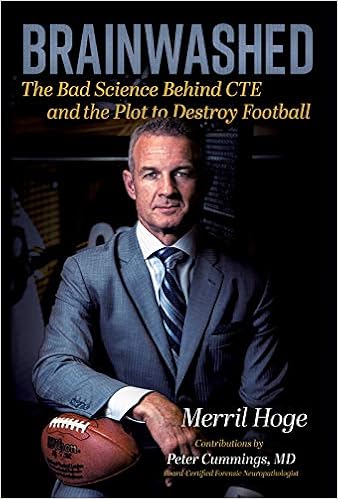
This book is a 5/5, one of the best books I have ever read. This book is a must read for any football fan, parents with children in youth sports, and anyone that wants to know more about CTE. Brainwashed by former NFL player and ESPN host Merril Hoge with help from doctor Peter Cummings (Board Certified Forensic Neuropathologist) was wrote in 2018 to defend football. Merril Hoge wrote this book to explain 3 myths in depth. The first that All NFL players are falling apart, second CTE is settled science and football causes it, and third youth football is child abuse. Merril Hoge also has a podcast that speaks about this subject at conferences. On the book’s website and in the book he gives things to know about CTE and questions for your youth football league.
Brainwashed by Merril Hoge
Myth #1
A lot of players struggle with what to do after their playing career. Some miss the crowd, the rush of playing, and after playing, having millions of dollars and nothing to do all day can lead a player to depression. The media only likes to report about players struggling with post-career life, instead of the number of NFL players that are in there 70s still living life. Merril Hoge explains why concussion causes him to retire early and the struggles he went through after his playing days.
Myth #2
Merril Hoge doesn’t say CTE is a myth, he just wants people to understand the connection between CTE and football isn’t as clear as the media makes it. Merril Hoge explains with doctor Cummings that some of the test done for CTE is extremely biased to make football causes CTE. Merril Hoge and Dr. Cummings grow through many studies and show why they are one-sided. Dr. Cummings explains that a brain with CTE appears to have Tau build up in the brain. Tau can be seen in numerous diseases and in aging, it is known that caused Tau in the brain is drug use, anabolic steroid use, obesity, chronic inflammation, and chronic stress. There also been studies that shown athletes having little to none Tau. When an injury to the head happens you need the right recovery to let the brain get back to 100% and rules/training for concussion have grown in the last 20 years rapidly, which is the best for the players and kids growing up.
Myth #3
Kids won’t atomically get CTE from youth sports, with only 0.9 kids from high school football players make it to the NFL. There are more pros than cons for kids to be in youth sports. Pros are the kids are playing a sport, with friends and learning characteristics instead of sitting on the couch and playing video games. Also, kids can hit there head riding a bike, jumping on the trampoline, and/or even running around and you can’t protect them from everything. Merril Hoge has a youth football league and he talks about with the right equipment, proper tackling training and right protocol for a concussion, youth leagues can be very positive for children.
To find this book and to learn more visit Merril Hoge official website http://merrilhoge.com/
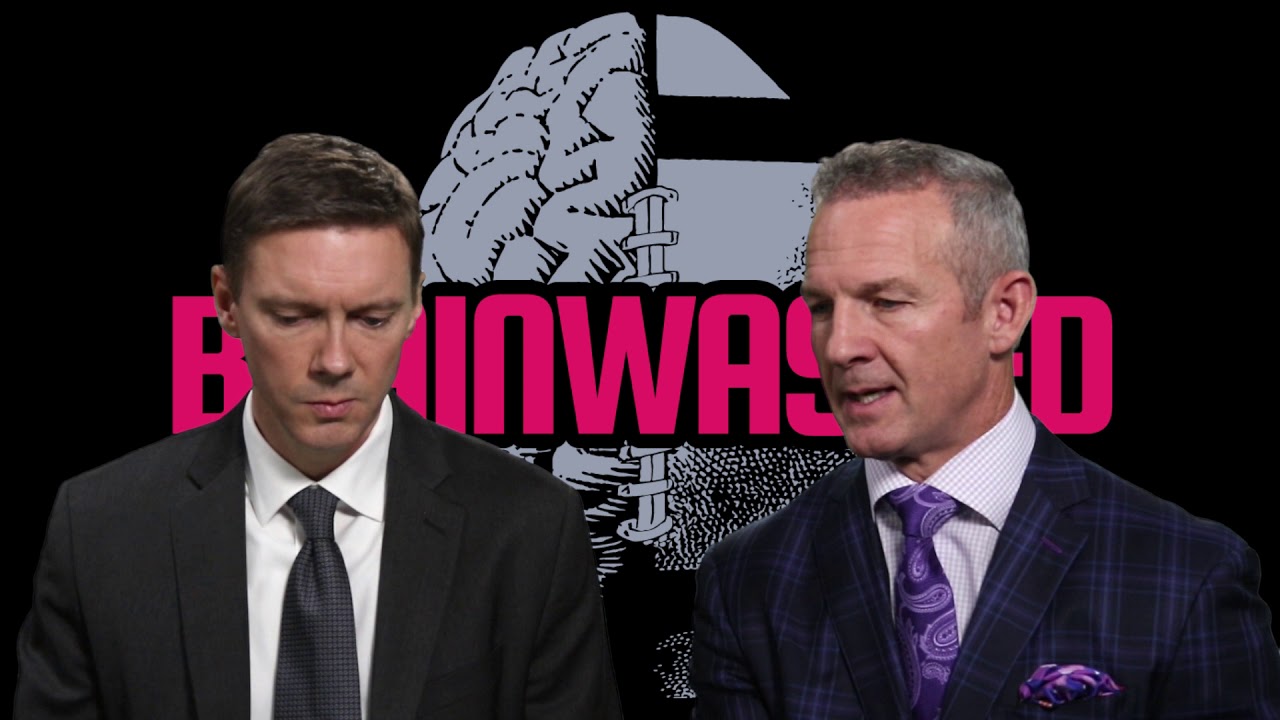
Brainwash authors, Dr Cumming and Merril Hoge (Picture from Youtube clip)
The Alliance of American Football (AAF) tried to become a developmental league for the NFL. The problem was that the NFL never helped them out as other sports leagues have. The NBA has its G-league, MLB has its minor leagues system and the NHL has their farm system. There have been many football leagues that have started and almost all have ended. The XFL is trying to make a comeback, and the AAF could look to team up with them. Since there is the Arena football league, Canadian football league, and many other minor league teams it is hard for other football leagues to develop. The AAF tried to be different with their rules; no kickoffs, have to go for two after touchdowns, limited pass rush, and no more onside kicks (onside conversion have to convert a 4th and 12). The Big 3 league has similarities and some key differences than the AAF. The Big 3 has different rules; a 4 point shot, first to 50 wins (have to win by 2), 14-second shot clock. Ice Cube’s league became the first sports league to legalize CBD for athletes to recover. The difference between the leagues is the Big 3 is a new kind of entertainment. The Big 3 is a 3 on 3 basketball league, unlike AAF trying to emerge with a new football league, Ice Cube founded a professional league that doesn’t have much competition. If the AAF wants to become a professional league and be successful they should change to a 7 on 7 leagues.
BIG 3 Founder ICE CUBE (Photo by Getty Images)
The Players
Another reason the AAF failed is the players they had. Although since the shutdown 30 plus guys from the league sign with an NFL team. The AAF is a developmental league the players were former NFL players, college stars or from other football leagues. Major players were former Heisman winner Trent Richardson, former Viking Matt Asiata and Charles Johnson, former Gopher David Cobb, and recently signed former Heisman winner Johnny Manziel. Many notable players in the league were former college QBs. The Big 3 is a bit different they use former NBA stars after their playing career. The first two season you had to be 30 years old, now they lowered it to 27 years old (to prevent injuries problem for the first two seasons). In their first season the Big 3 sign former NBA MVP Allen Iverson who eventually wasn’t fit to play and didn’t show up to a game, and NBA star Jason Williams who got injured on opening night. Signing these big names made fans interested in the league from the start. Other stars still in the league are Nate Robinson, Chauncey Billups, Metta World Peace, Mahmoud Abdul-Rauf, Mike Bibby, Former Timberwolves Rashad McCants, and Rashard Lewis. With the addition of 4 more teams, the league needs more players and they sign many with talent; NBA champion Kendrick Perkins, Gilbert Arenas, Former Timberwolves all-star Al Jefferson, Former number 1 pick Greg Oden, Lamar Odom, former Atlanta Hawks teammates Joe Johnson and Josh Smith. Ice Cube is often tweeting at NBA all-stars Shaq, Kobe, Dwayne Wade, and any other player that is retired. The Big 3 with all these former NBA players make fans want to watch the games, compared to a developmental league with many players that fans never heard of.
Big 3 tweets out Lamar Odom joining the Big 3 League (Photo by Big 3 twitter)
Marketing
Reasons it is hard to start and grow a sports league is marketing. The leagues can have the best set up and design but without fans, they are doom to fail. One of the Big 3 first major problems they had to face was the games were played on Facebook watch and FS1 for fans until they reach a deal with CBS for this season. The AAF had a deal with CBS from the start, which is probably a reason they were so far in debt they had to shut down the league. Another reason is the location; Big 3 has no hometown, while the AAF had cities like Orlando, Arizona. For a fan to become a fan of a new team it is easier for a fan to become a fan of the Killer 3’s in the Big 3 league compare to a fan from Minnesota to become a fan of the Arizona Hotshots. Also, the Big 3 is played in major cities around the united states to reach its audience, they grew from one night to Saturday/Sundays now with 12 teams. While the AAF teams are all in the south, after many fans and viewers in week 1 (had more viewers than Rockets vs. Thunder) the numbers just fell and fell. Since the location doesn’t change for the AAF it is hard for the league to reach all of its audience. The last major reason is the timing of the seasons, while everyone loves football a week after the Superbowl wasn’t the best time to start. With college basketball, NHL and NBA approach playoffs, the start of baseball all get in the way for the viewers of AAF games. Also, the weather with rain/snow got fans to get away from the league. Fans are going to watch all those sports teams they have been cheering on for years compared to a new sports league with many players they don’t know about. As we saw with many viewers buying into week 1 the viewers eventually went back to there favorite teams. The Big 3 starts in the summer where there are fewer sports going on and allow fans to go to big arenas to watch there favorite former NBA All-stars. The AAF average attendance was around 18,000 compared to Big 3 first season was sold out. The social media use of the Big 3 is one of their biggest strengths you can often see tweets from Big 3 league for the news update, players signing, game recaps. Ice cube also tweets often, replies to people and is very good at interacting with the fans. The AAF I didn’t sense the same from, other then the game updates from each individual team, there wasn’t much fans interaction. The AAF was a good idea with some bad planning, they needed to reach an agreement with the NFL before the season, and have better planning, Good luck to the XFL and other football leagues starting up. Make sure to watch the Big 3 league this summer with the CBS deal, as well as growing the league and RIP to the AAF.
Giving followers an insight on sports news and topics, from debates to movie/book reviews all sports new with our honest opinion. No bias, No hiding facts, just the cold hard truth. Local Minnesota sports will be the strong point of this site but we also do any other professional teams and leagues.
Authors
Nate Gehlen; the founder of the Chomp, started this blog to get readers more informed about some of the biggest moments/topics/debates in sports. He played football at the University of Minnesota-Morris, and grew up in Woodbury, MN. He has always had a love for sports growing up trying hockey, and playing baseball, football and basketball. He is a huge Minnesota sports fan, as well as the Florida Gators.


 Chomping at the Bit